The Digital Vault: Mobile Storage in 2026
ROM, or Read-Only Memory, has undergone a radical transformation in the mobile industry. In 2026, it is no longer just a static repository for your photos and apps; it has evolved into a high-performance architectural component essential for on-device AI and real-time data processing. While many users focus on performance metrics, understanding the difference between storage and memory is crucial—much like knowing what is mobile RAM can help you choose the right flagship for your needs.
In modern smartphones, "ROM" technically refers to the internal flash storage where your operating system, user data, and applications reside permanently. Unlike RAM, which clears when you restart your phone, ROM keeps your data safe even without power.
UFS 4.1 and the Dawn of UFS 5.0

By early 2026, UFS 4.1 (Universal Flash Storage 4.1) has become the gold standard for high-end devices like the Oppo Find X6 Pro. This standard offers sequential read speeds of up to 4,200 MB/s, allowing for near-instant app launches and seamless 8K video playback. However, the industry is already looking ahead to the late-2026 rollout of UFS 5.0, which promises to double these speeds to a staggering 10.8 GB/s.
This leap in speed is primarily driven by the need for low-latency access to Large Language Models (LLMs) that live locally on your device. Companies like Samsung and Micron are leading the manufacturing charge to meet these extreme performance demands.
Why On-Device AI Changes Everything

In 2026, your phone's storage isn't just "big"—it's "smart." On-device AI requires the ROM to feed data to the NPU (Neural Processing Unit) at speeds that were previously only seen in desktop workstations. This high-throughput storage is vital when you are using advanced creative tools, such as the ai texture mapper in Picsart, which requires processing complex 3D maps and high-resolution textures in real-time.
If your device uses outdated storage (like eMMC or UFS 2.2 found in older budget models), these AI features will feel sluggish, regardless of the processor's speed. The vibrant colors of OLED technology deserve to be fed by high-speed storage that can render top-tier visual assets without buffering.
ROM vs. RAM: A 2026 Comparison
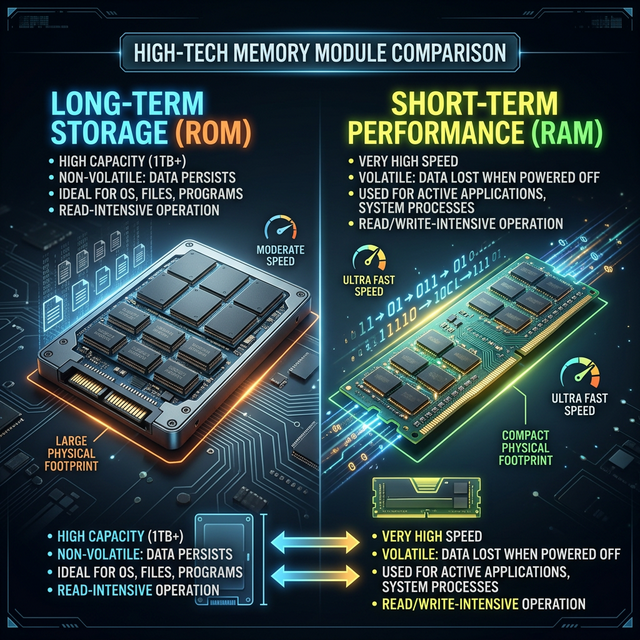
It is common for users to confuse these two terms. In 2026, the distinction is clear: ROM is your massive digital warehouse, while RAM is the hyper-fast executive desk where immediate tasks are handled. While they work together, they use different technologies—UFS for ROM and LPDDR6 for RAM—to maximize your phone's efficiency.
Even if you have the latest hardware, software maintenance remains important for financial security. For example, if you haven't used your wallet apps due to a storage upgrade, you might need to learn how to reactivate an Easypaisa account to ensure your biometric data is correctly synced with your new high-speed storage encrypted module.
Mobile Storage Tiers and Standards (2026)
| Storage Standard | Typical Read Speed | Best Use Case (2026) |
|---|---|---|
| UFS 2.2 / 3.1 | Max 2,100 MB/s | Budget devices and entry-level tablets. |
| UFS 4.0 / 4.1 | 4,200 MB/s | Standard for 2025/2026 flagships and AI phones. |
| UFS 5.0 (Upcoming) | 10,800 MB/s | Next-generation gaming and spatial computing. |
| NVMe (Custom) | Various | Found in Apple iPhones and specialty high-end devices. |
Frequently Asked Questions (FAQ)
Can I expand my phone's ROM with a MicroSD card?
In 2026, most flagship devices have removed the MicroSD slot to favor the high speeds of internal UFS storage. However, many mid-range brands like Realme and Xiaomi still offer expansion slots, though external cards are significantly slower than internal ROM.
Does a full storage (ROM) slow down my phone?
Yes. Modern flash storage requires "breathing room" for a process called Wear Leveling. If your storage is 95% full, you will notice significant lag during file saving and app switching.
How much ROM do I need in 2026?
For the average user, 256GB is the recommended baseline. Power users, especially those recording 8K video or using large generative AI models, should prioritize 512GB or 1TB options from manufacturers like Google.
What is the difference between ROM and internal storage?
While often used interchangeably in smartphone marketing, "ROM" technically refers to the non-volatile chips, while "Internal Storage" is the user-accessible portion of those chips.
Why is my phone's "System Data" taking up so much ROM?
The operating system and hidden partitions for AI model residency can take up 30-60GB of space. This ensures that the phone's core functions run at maximum hardware speed.