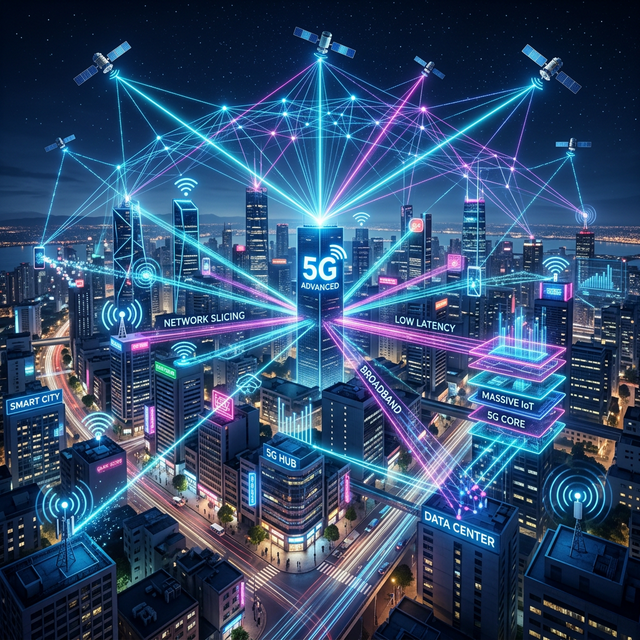
The Invisible Architecture of Modern Connectivity
When you stream a 4K video seamlessly on a crowded subway in 2026, you aren't just tapping into a larger physical pipe of data. You are experiencing the real-time orchestration of highly complex radio engineering. The jump from legacy networks to modern 5G wasn't simply an upgrade in broadcast power; it was a fundamental redesign of how radio waves are manipulated, directed, and managed.
To fully appreciate these mechanisms, it helps to understand the historical context. We highly recommend reviewing our complete Evolution of Mobile Networks (1G to 5G) guide to see how we progressed from basic voice calls to the multi-gigabit data streams of today.
The core philosophy of 5G relies on four primary mechanisms working in absolute tandem: Network Slicing, Millimeter Wave (mmWave) frequencies, Beamforming, and Massive MIMO.
1. Network Slicing: Virtualizing the Airwaves
In previous cellular generations, all traffic—whether an automated smart meter sending 10 bytes of data or a teenager streaming a high-definition movie—was treated essentially the same on the physical infrastructure. 5G fundamentally changed this through Network Slicing.
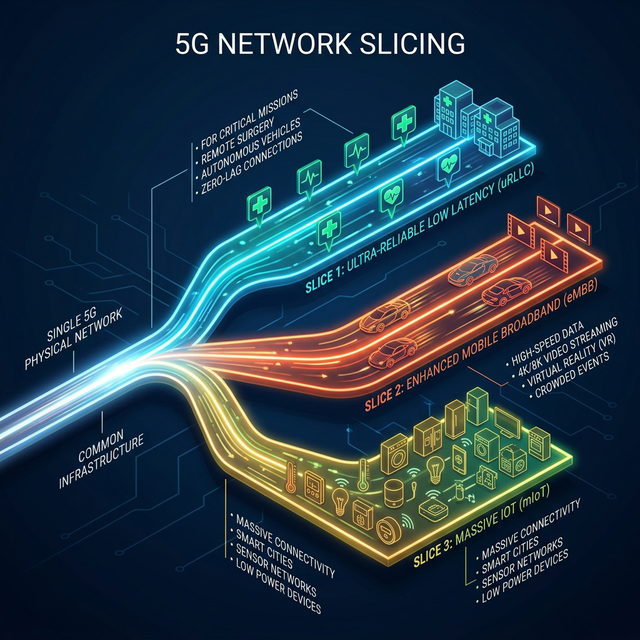
Network slicing is an architectural approach built on Software-Defined Networking (SDN) and Network Functions Virtualization (NFV). It allows a single physical network infrastructure—the cell towers and fiber backbones—to be divided into multiple virtual, entirely isolated logical networks.
Each "slice" is tailormade to provide specific Quality of Service (QoS). For example, a hospital deploying remote surgery robotics requires an Ultra-Reliable Low Latency Communications (URLLC) slice where dropped packets are unacceptable, but overarching bandwidth needs are moderate. Conversely, a stadium of fans uploading videos requires an enhanced Mobile Broadband (eMBB) slice focused purely on massive throughput. In 2026, network operators like Verizon and Vodafone lease these dedicated, guaranteed slices directly to enterprises.
2. The Spectrum Leap: Exploring mmWave
Data transmission requires spectrum. To achieve the massive throughput required in 2026, 5G had to tap into previously unused, much higher-frequency real estate on the electromagnetic spectrum: the Millimeter Wave (mmWave) bands, typically located between 24 GHz and 100 GHz.
Because these frequencies are so high, their wavelengths are incredibly short (measured in millimeters). These short wavelengths allow for massive data payloads. However, mmWave comes with severe physical limitations. Unlike the lower frequencies of 4G that can penetrate concrete buildings and travel for miles, mmWave signals degrade rapidly over short distances and can be blocked by foliage, rain, or even human hands blocking a phone antenna. (This is partly why NFC and wireless charging protocols have become so specific in modern devices; for a deep dive, see our article on iPhone 15 Pro NFC Issues with BMW Charging).
3. Massive MIMO: Increasing the Antenna Density
To overcome the fragility of mmWave, telecom engineers combine it with dense infrastructure. Instead of relying on a few massive macro-towers covering vast areas, 5G relies heavily on "Small Cells" placed on streetlamps and buildings.
Attached to these small cells is the third critical mechanism: Massive MIMO (Multiple Input, Multiple Output). While older 4G antennas might have featured an array of 4 or 8 transmit/receive elements, a 2026 Massive MIMO base station can house 64, 128, or even 256 individual antenna elements packed tightly onto a single panel. This monumental increase in antenna density dramatically boosts the spectral efficiency and capacity of the network, resolving congestion in densely populated areas.
4. Beamforming: The Precision Spotlight
If you have hundreds of antennas transmitting simultaneously (Massive MIMO), how do you prevent the signals from interfering with one another and turning into chaotic noise? The answer is Beamforming.
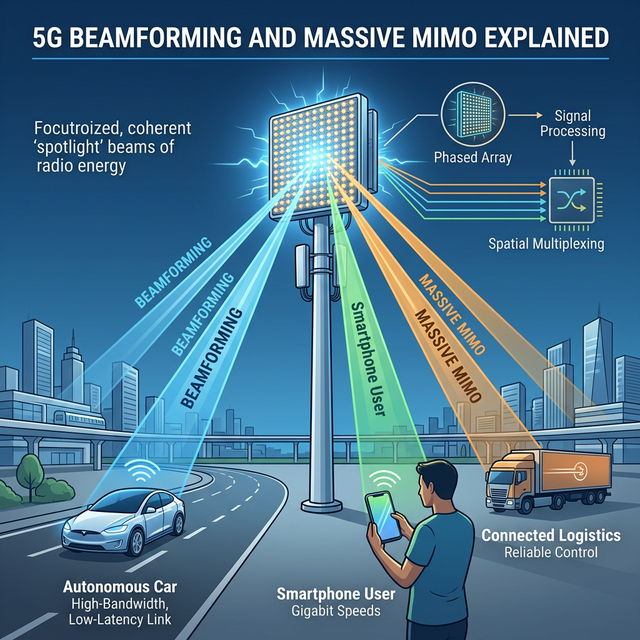
Traditional cell towers operate like floodlights, blasting a wide signal radially in all directions. Beamforming acts like a laser-guided spotlight. Utilizing advanced digital signal processing algorithms, the phased-array antennas in a Massive MIMO setup can constructively interference their radio waves.
The result is a precisely sculpted "beam" of radio frequency energy targeted directly at an individual user's smartphone or autonomous vehicle as it moves down the street. It minimizes wasted energy and drastically reduces interference with neighboring users. Companies like Ericsson and Nokia have perfected these algorithms over the past few years, making gigabit mmWave connections reliable.
Hardware Impact on the User Experience
Receiving these massive, targeted multi-gigabit streams demands powerful internal modems and robust screens to view the high-fidelity content seamlessly. As 5G speeds enable real-time 4K rendering and cloud gaming, the visual quality of your device's panel becomes paramount. Make sure you understand how hardware parses this incoming data by reviewing our guide on Phone Display Types in 2026.
Furthermore, managing these large data packages often means managing large data plans. If you're utilizing heavy 5G in regions where data caps still apply, understanding local carrier network balances is critical; for an example of regional management, check out our guide on How to Share Telenor Balance.
Frequently Asked Questions
Does 5G Network Slicing violate Net Neutrality?
This is a major regulatory debate in 2026. While critics argue prioritizing certain enterprise "slices" violates the spirit of treating all internet traffic equally, proponents (and many regulators) argue that slicing is necessary for functional infrastructure, such as ensuring an autonomous vehicle's data isn't delayed by a neighboring Netflix stream.
Can my phone use mmWave everywhere?
No. Even in 2026, mmWave is primarily deployed in dense urban corridors, stadiums, and airports. For broad, rural, or suburban coverage, 5G relies on lower-frequency "Sub-6" spectrum bands.
Do I need a new SIM card to access Network Slicing?
For standard consumer plans, your device automatically connects to the default enhanced Mobile Broadband (eMBB) slice natively securely handled by your carriers eSIM configuration. You do not need specialized hardware beyond a 5G-capable handset.
How does Beamforming save battery?
By focusing radio energy directly at your phone rather than relying on weak scatter signals, your phone's internal modem spends less physical power hunting for and maintaining a stable reception, passively extending your battery life.