The Evolution of Mobile Networks
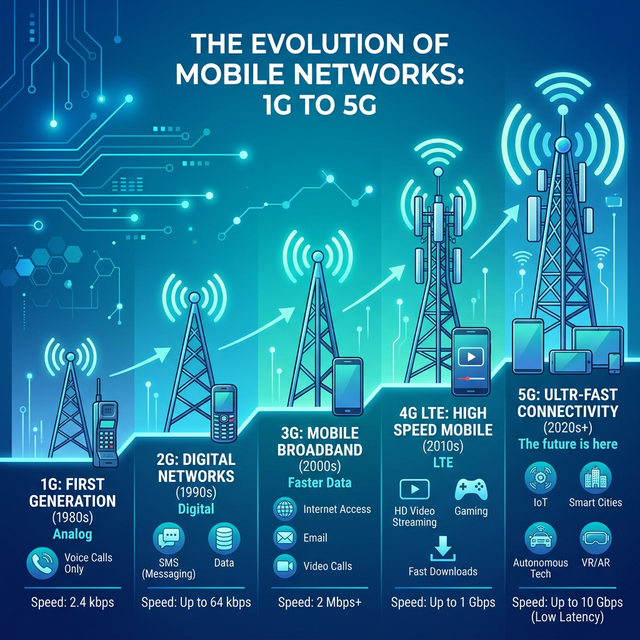
Mobile network technology has undergone a remarkable transformation over the past four decades. From the analog voice calls of 1G in the 1980s to the ultra-fast, low-latency capabilities of 5G in 2026, each generation has fundamentally changed how we communicate, work, and live. Understanding this evolution helps you appreciate the technology powering your smartphone today and what's coming next with 6G.
1G – The Birth of Mobile Communication
Overview
1G (First Generation) networks launched in the late 1970s and early 1980s, introducing the world to mobile voice communication for the first time. Based on analog technology like the Advanced Mobile Phone System (AMPS), 1G enabled basic voice calls using radio signals.
Key Characteristics
- Technology: Analog (AMPS, NMT, TACS)
- Speed: ~2.4 Kbps
- Capability: Voice calls only
- Limitations: No encryption, poor voice quality, heavy interference, no data services
- Era: 1979–2000s
1G networks were decommissioned by the early 2000s as digital technology took over.
2G – The Digital Revolution
Overview
Launched in the early 1990s, 2G marked the critical transition from analog to digital signals. The GSM standard became the dominant technology, bringing improved voice quality, call encryption, and the birth of text messaging (SMS).
Key Characteristics
- Technology: GSM, CDMA
- Speed: 14.4–64 Kbps (up to 217.6 Kbps with EDGE)
- Capabilities: Digital voice, SMS, basic internet (WAP), MMS
- Enhancements: GPRS (2.5G) and EDGE (2.75G) added packet-switching for data
- Era: 1991–present (some networks still active)
Impact
2G democratized mobile communication globally. The introduction of SMS created an entirely new form of human communication, and GPRS enabled the first mobile internet experiences. Many developing countries still utilize 2G networks for basic connectivity.
3G – Mobile Internet Era
Overview
3G networks, launched in the early 2000s, represented a massive leap in data speeds, ushering in the mobile internet era. Technologies like UMTS and CDMA2000 enabled web browsing, video calling, and multimedia services on mobile devices.
Key Characteristics
- Technology: UMTS, CDMA2000, HSPA
- Speed: 144 Kbps–42 Mbps (HSPA+)
- Capabilities: Web browsing, video calls, mobile TV, app stores, GPS navigation
- Enhancements: HSPA (3.5G) and HSPA+ (3.75G) significantly boosted speeds
- Era: 2001–present
Impact
3G transformed mobile phones into "mini-computers." The launch of the iPhone in 2007 and the App Store in 2008 coincided with 3G availability, creating the smartphone revolution. Social media, mobile gaming, and streaming services all became possible thanks to 3G data speeds.
4G LTE – The Broadband Experience
Overview
4G LTE (Long Term Evolution), introduced in the late 2000s and early 2010s, delivered true mobile broadband. By moving to an all-IP (Internet Protocol) architecture, 4G eliminated circuit switching and enabled high-definition streaming, online gaming, and the expansion of IoT.
Key Characteristics
- Technology: LTE, LTE-Advanced, LTE-Advanced Pro
- Speed: 100 Mbps–1 Gbps (LTE-A)
- Capabilities: HD/4K streaming, VoLTE, mobile gaming, IoT
- Latency: 30–50ms
- Era: 2009–present
Impact
4G LTE made mobile the primary internet access point for billions of people. Streaming services like Netflix and YouTube thrived on 4G speeds. Ride-sharing apps, food delivery, and the gig economy were all built on 4G infrastructure.
5G – The Connected Future
Overview
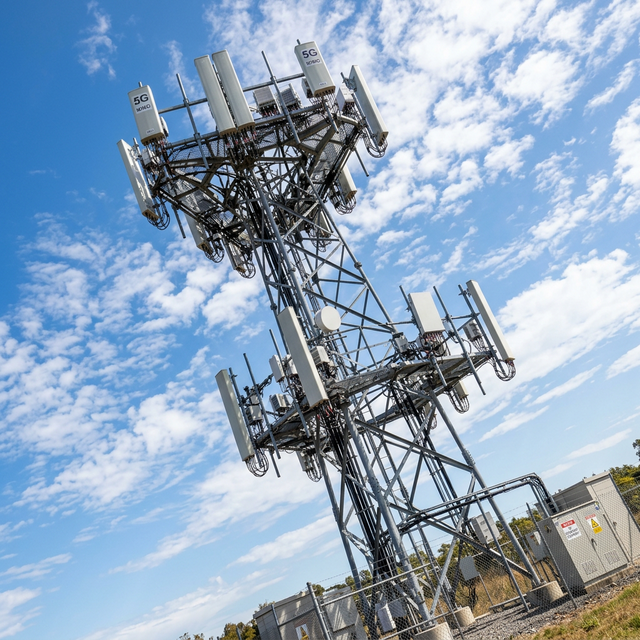
5G, first deployed in 2019, represents the most significant advancement in mobile connectivity. With speeds up to 10 Gbps, latency as low as 1 millisecond, and the ability to connect millions of devices per square kilometer, 5G enables applications that were previously impossible.
Key Characteristics
- Technology: NR (New Radio), OFDM
- Speed: 1–10 Gbps (theoretical peak: 20 Gbps)
- Latency: 1–10ms
- Bands: Sub-6 GHz, mmWave (millimeter wave)
- Key Use Cases:
- eMBB – Enhanced Mobile Broadband (8K streaming, VR/AR)
- URLLC – Ultra-Reliable Low-Latency Communications (autonomous vehicles, remote surgery)
- mMTC – Massive Machine-Type Communications (smart cities, IoT)
Impact in 2026
By 2026, 5G networks span most urban areas globally. The technology powers autonomous vehicles, smart manufacturing, remote healthcare, and immersive AR/VR experiences. For the latest 5G-compatible phones, explore our best affordable smartphones guide. To ensure your phone's connectivity, learn about using Wi-Fi calling to improve connectivity.
Comparison: 1G to 5G at a Glance
| Feature | 1G | 2G | 3G | 4G LTE | 5G |
|---|---|---|---|---|---|
| Year Launched | 1979 | 1991 | 2001 | 2009 | 2019 |
| Technology | Analog | Digital (GSM) | UMTS/HSPA | LTE | NR |
| Max Speed | 2.4 Kbps | 217 Kbps | 42 Mbps | 1 Gbps | 10+ Gbps |
| Latency | N/A | 300–1000ms | 100–500ms | 30–50ms | 1–10ms |
| Core Service | Voice | Voice + SMS | Mobile Internet | Mobile Broadband | IoT + AI + AR/VR |
| Signal Type | Analog | Digital | Digital | All-IP | All-IP |
The Road to 6G
What to Expect
2026 marks a pivotal year for 6G development. At MWC Barcelona 2026, Qualcomm announced a strategic coalition to accelerate 6G development, with commercial systems projected to launch from 2029.
Key 6G predictions include:
- 1 Tbps speeds – Up to 100x faster than 5G
- AI-native architecture – AI integrated into the network core for autonomous optimization
- Sub-millisecond latency – Enabling real-time holographic communication
- Satellite integration – Seamless connectivity anywhere on Earth
- Sensing capabilities – Networks that can detect and map the physical environment
How Mobile Networks Affect Your Smartphone
Speed and Streaming
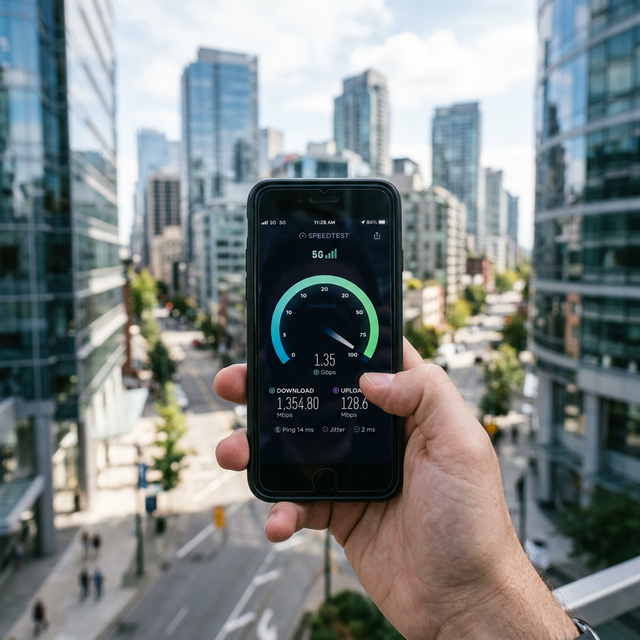
Your phone's network generation determines download speeds, streaming quality, and app responsiveness. A 5G connection can download a full HD movie in seconds, while 3G would take hours. To make the most of your connection, check out our guide on how to check your Wi-Fi password.
Battery Consumption
5G connectivity can consume more battery than 4G, especially when using mmWave bands. Learn how to adjust screen settings to extend battery life while using data-intensive 5G applications.
Phone Compatibility
Not all phones support every network generation. Budget phones may only support 4G, while flagships offer full 5G capabilities. Always check the supported bands when purchasing a new device. Explore the latest Samsung mobile phones for 5G options.
Frequently Asked Questions (FAQ)
Is 5G available everywhere in 2026?
5G coverage has expanded significantly but is still primarily concentrated in urban areas. Rural areas often rely on 4G LTE, while 5G mmWave is limited to dense city centers. Sub-6 GHz 5G offers broader coverage but slower speeds.
Do I need a new phone for 5G?
Yes, you need a 5G-compatible phone and a 5G plan from your carrier. Most phones released since 2021 support 5G. Check your phone's specifications or contact your carrier for compatibility details.
Is 5G safe?
Yes. According to the World Health Organization and numerous scientific studies, 5G radio frequencies are within safe limits and pose no known health risks. The frequencies used by 5G are similar to those already used by 4G, Wi-Fi, and television broadcasts.
Will 4G be shut down?
4G LTE will remain active for years to come. Telecom operators typically maintain older networks for 10–15 years after newer ones launch. 3G networks are being gradually decommissioned, but 4G will coexist with 5G throughout the 2020s and into the 2030s.
What is the difference between sub-6 GHz and mmWave 5G?
Sub-6 GHz 5G offers wider coverage and decent speeds (up to 1–2 Gbps), while mmWave provides blazing-fast speeds (up to 10+ Gbps) but only in very limited areas with direct line-of-sight. Most consumer 5G in 2026 uses sub-6 GHz bands.