When purchasing a flagship smartphone today, the term "AMOLED" is heavily marketed as a premium, must-have optical feature. But what exactly separates this technology from standard LCDs, and why do leading manufacturers exclusively equip their most expensive devices with it? The answer lies in microscopic physics and independent pixel illumination.
The Magic of Active Matrix Organic LEDs
AMOLED stands for Active Matrix Organic Light-Emitting Diode. Traditional LCD panels fundamentally require a massive, continuous backlight layer strategically positioned behind the screen to blindly push artificial light outward through complex liquid crystals to form an image. This architectural limitation means the entire screen is always illuminated when the display is active.
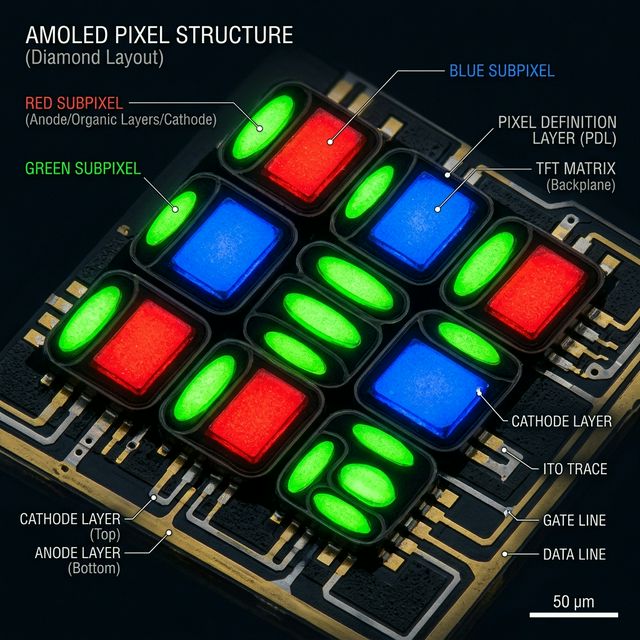
Conversely, AMOLED technology entirely removes the backlight requirement. Instead, the screen consists of millions of microscopic organic diodes. Each individual pixel acts as its own autonomous light source, producing distinct RGB colors directly when electricity passes through it.
Infinite Contrast and True Blacks
This independent control yields the greatest advantage of AMOLED: the ability to display perfect "true black." Because a standard LCD constantly uses a backlight, attempting to display a black image results in a washed-out, dark gray glow. The crystals simply try to block the backlight, which is never entirely successful.
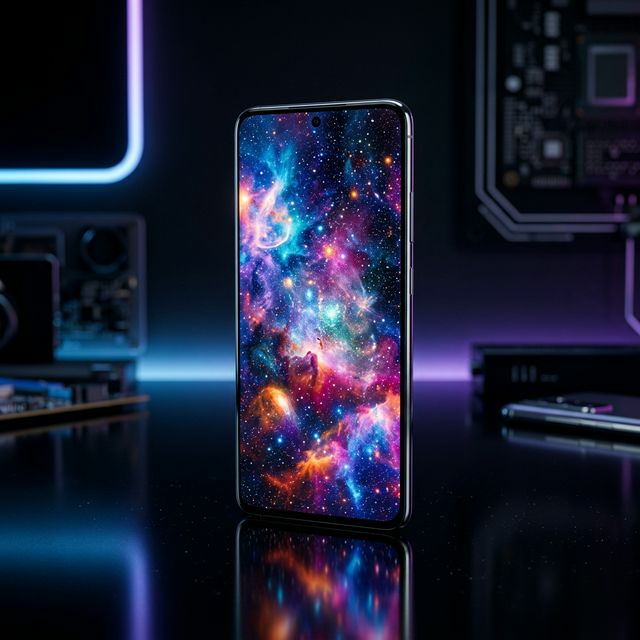
With AMOLED, generating a black hue is incredibly simple: the software literally cuts power to those specific pixels, turning them entirely off. The resulting lack of light creates an infinite contrast ratio, making vibrant colors appear dramatically richer and punchier.
Dark Mode Battery Efficiency
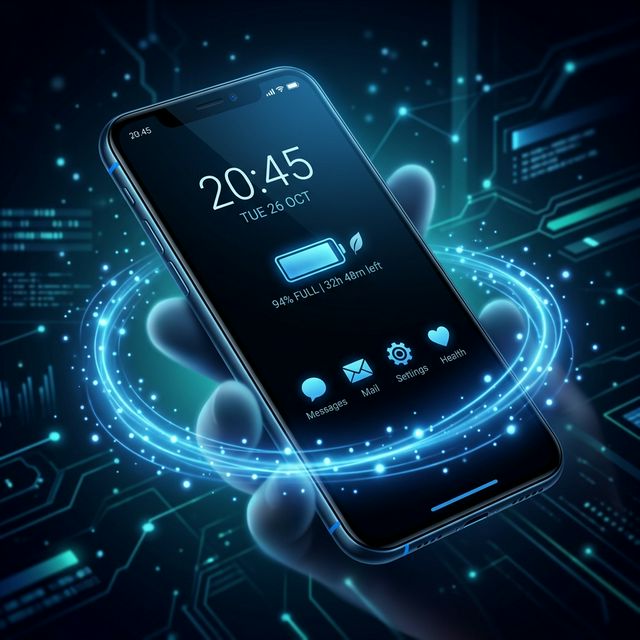
Because AMOLED pixels displaying black are functionally devoid of electrical current, modern operating systems rely upon Dark Modes to dramatically extend battery life. Staring at a dark theme on an AMOLED display directly reduces processor output and screen energy drain simultaneously.
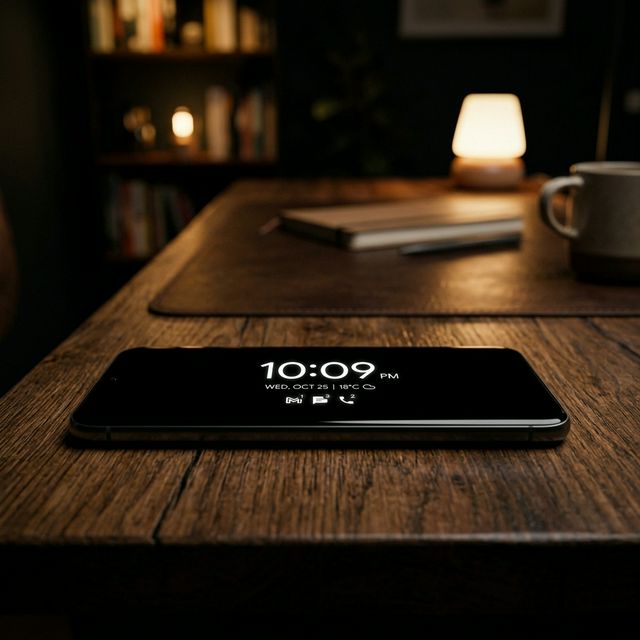
This efficiency also enables the popular Always-On Display (AOD). By illuminating only a small fraction of white pixels to form a minimalist digital clock, the phone can continuously display notifications while leaving the remaining 95% of the screen completely powered down, resulting in negligible battery drain.