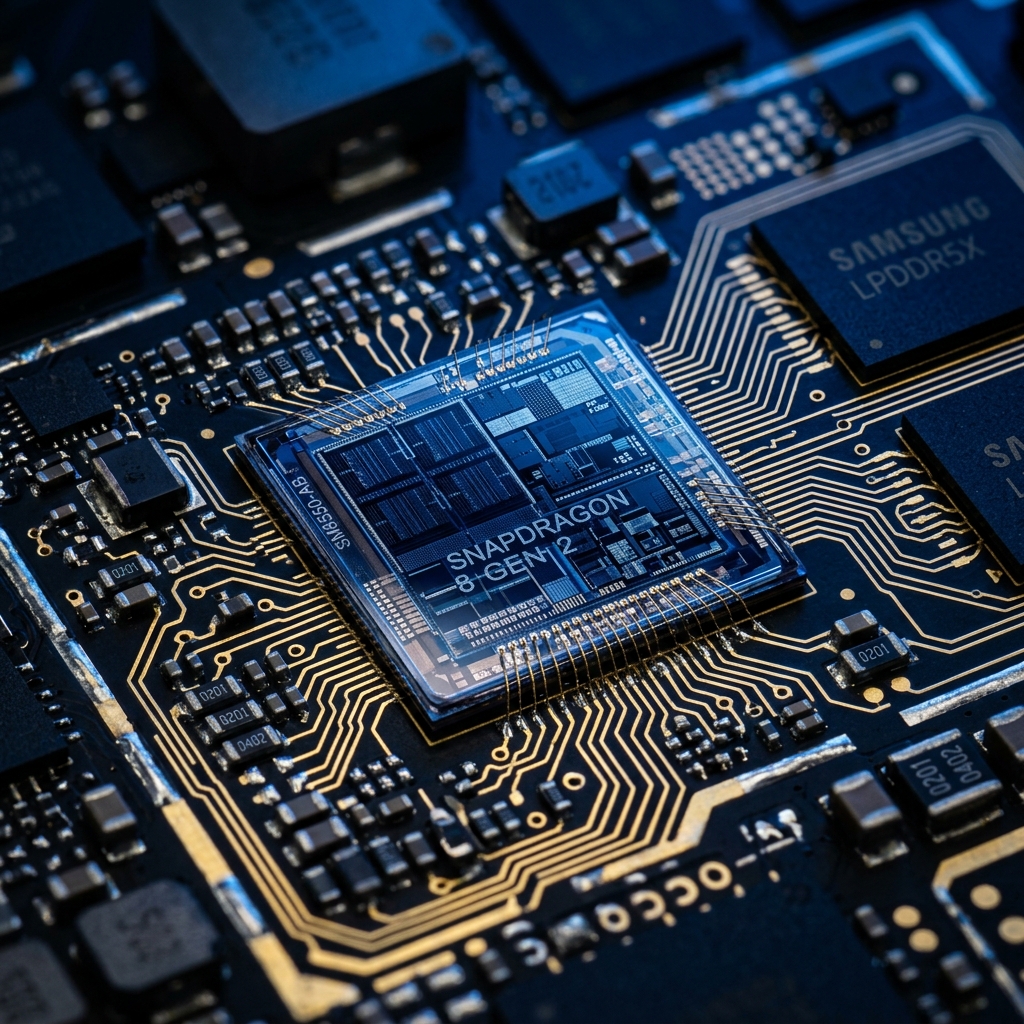
When comparing smartphones, the chipset (also called the processor or SoC) is one of the most important specifications that determines how fast, efficient, and capable your device will be. The chipset is essentially the brain of your smartphone, controlling everything from app performance and gaming to camera processing and battery life. This guide explains exactly what a chipset is, what its components do, and why it matters when choosing a phone in 2026.
What is a Chipset?
A chipset in the context of smartphones is a System-on-Chip (SoC), a single integrated circuit that combines multiple processing components onto one tiny silicon chip. Unlike desktop computers where the processor, graphics card, modem, and other components are separate physical chips, a smartphone SoC integrates all of these onto a single piece of silicon smaller than a fingernail. This integration is essential for the compact size, power efficiency, and thermal management requirements of mobile devices.
Chipset vs Processor
While people often use "chipset" and "processor" interchangeably, there is a technical difference. The processor (CPU) is just one component within the chipset. The chipset is the entire SoC package that includes the CPU along with the GPU, modem, ISP, NPU, memory controller, and other specialized processing units. When someone says a phone has a "Snapdragon 8 Gen 3 processor," they are technically referring to the entire Snapdragon 8 Gen 3 chipset that contains multiple processors working together.
Components Inside a Chipset
A modern smartphone chipset contains several specialized processing blocks, each responsible for different functions.
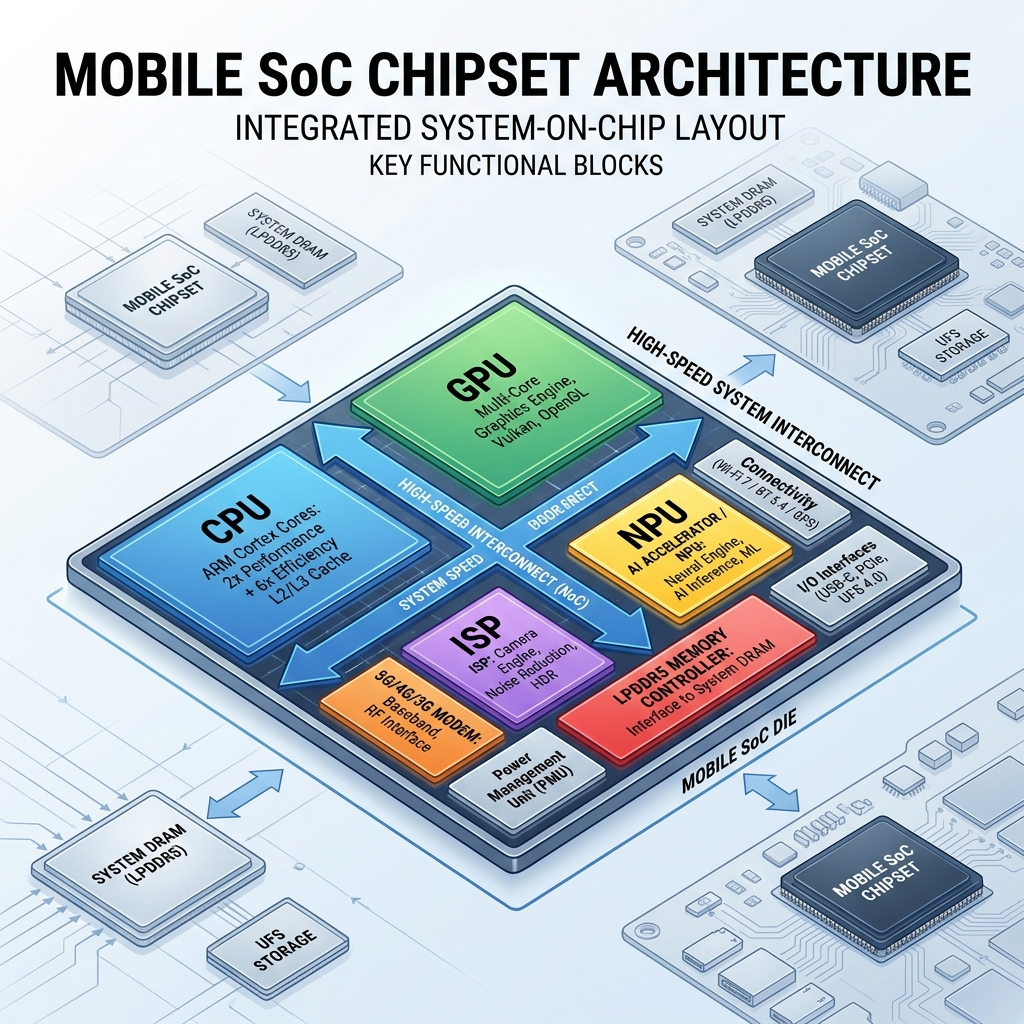
CPU (Central Processing Unit)
The CPU is the primary general-purpose processor that handles the majority of computational tasks. It runs the operating system, executes app code, processes user inputs, and manages system resources. Modern mobile CPUs use a multi-core design with different types of cores optimized for different workloads. A typical flagship chipset in 2026 features a big.LITTLE or DynamIQ architecture with one ultra-high-performance "prime" core for demanding single-threaded tasks, three high-performance cores for multitasking and heavy workloads, and four efficiency cores for background processes and light tasks like messaging and music playback.
GPU (Graphics Processing Unit)
The GPU handles all graphics rendering including the user interface animations, 2D and 3D game graphics, video playback, and image processing. A powerful GPU is essential for smooth gaming performance, high refresh rate display support, and GPU-accelerated computational photography. Qualcomm uses Adreno GPUs, Apple uses custom-designed GPUs, MediaTek uses Arm Mali or Immortalis GPUs, and Samsung Exynos recently adopted AMD RDNA-based Xclipse GPUs.
Modem (Cellular Connectivity)
The modem handles all cellular network communication including 4G LTE and 5G data, voice calls, and SMS. An integrated modem built directly into the SoC is more power-efficient than an external modem chip. The modem determines which network bands your phone supports, the maximum download and upload speeds, and whether the phone can connect to 5G sub-6 GHz and mmWave networks. Qualcomm Snapdragon X75 and MediaTek M80 are examples of advanced 5G modems integrated into their respective chipsets.
ISP (Image Signal Processor)
The ISP processes raw data from the camera sensor and converts it into the photographs and videos you see on screen. It handles autofocus algorithms, white balance, noise reduction, HDR processing, and multi-frame computational photography. A more advanced ISP can process data from higher-resolution sensors faster, support more cameras simultaneously, and run more sophisticated image processing algorithms. This is why two phones with the same camera sensor can produce very different quality photos depending on the chipset ISP.
NPU (Neural Processing Unit)
The NPU is a dedicated processor designed specifically for artificial intelligence and machine learning tasks. AI workloads include voice recognition, face detection and recognition, scene identification in the camera app, real-time language translation, predictive text input, and smart battery management. The NPU can execute AI models far more efficiently than the CPU or GPU, performing trillions of operations per second (TOPS) while consuming minimal power.
Memory Controller
The memory controller manages data flow between the processor and RAM (Random Access Memory). It determines what type and speed of RAM the chipset supports, such as LPDDR5 or LPDDR5X. Faster memory means quicker app loading, smoother multitasking, and better overall system responsiveness. The memory controller also manages UFS (Universal Flash Storage) communication for reading and writing data to the internal storage.
Major Chipset Manufacturers
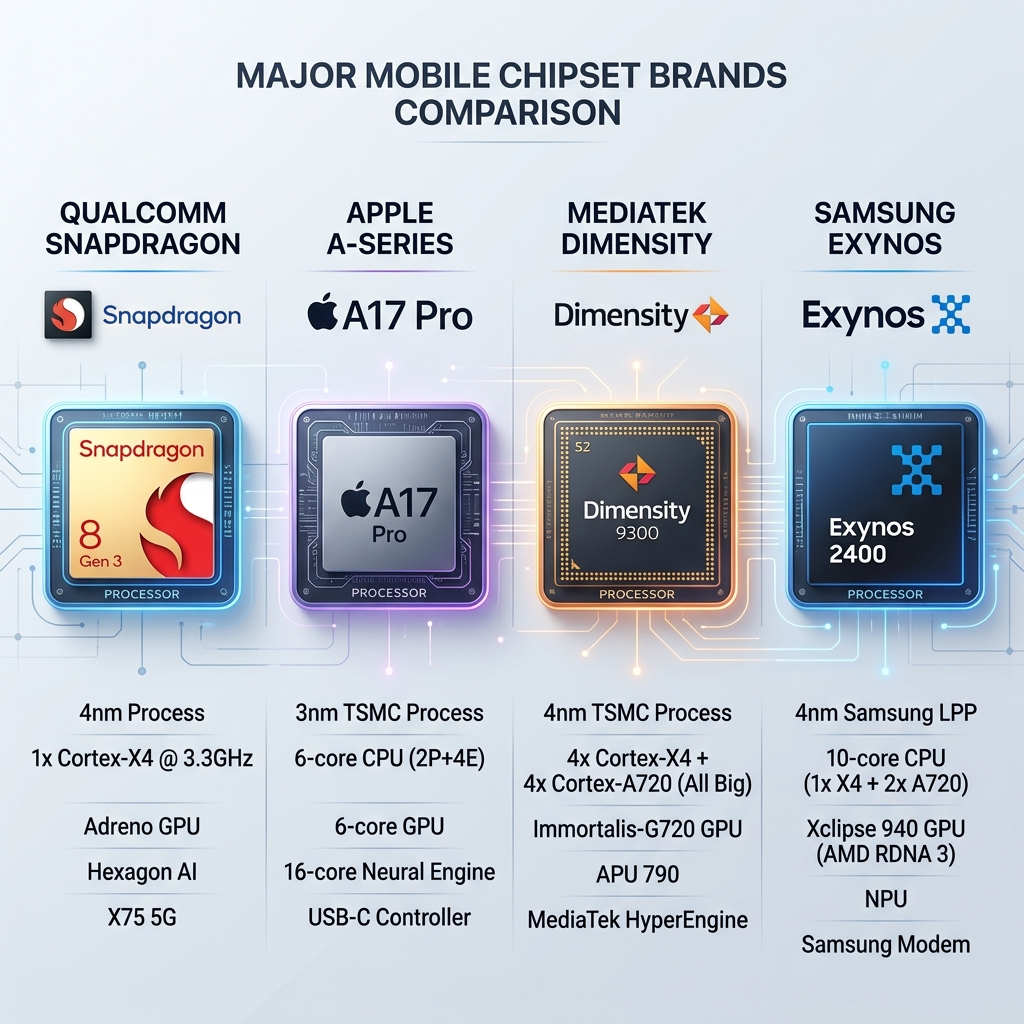
Qualcomm Snapdragon
Qualcomm is the dominant chipset supplier for Android smartphones. Their Snapdragon series ranges from the budget Snapdragon 4 series through the mid-range Snapdragon 6 and 7 series to the flagship Snapdragon 8 series. Snapdragon chipsets are known for excellent 5G modem integration, strong GPU performance, and broad device compatibility. Major brands using Snapdragon include Samsung, Xiaomi, OnePlus, Sony, and ASUS.
Apple A-Series and M-Series
Apple designs its own chipsets exclusively for iPhones, iPads, and Macs. The A-series chips (like A17 Pro) are used in iPhones and consistently lead in single-core CPU performance benchmarks. Apple tight integration between its custom silicon and iOS software results in exceptional real-world performance and power efficiency that often surpasses competitors with higher on-paper specifications.
MediaTek Dimensity
MediaTek has grown significantly in market share with its Dimensity series, offering competitive performance at lower price points than Qualcomm. The Dimensity 9000 series competes with Snapdragon 8 series in flagship devices, while the Dimensity 7000 and 6000 series dominate the mid-range and budget segments. Samsung, Xiaomi, Oppo, Vivo, and Realme use MediaTek chipsets across their product lineups.
Samsung Exynos
Samsung designs Exynos chipsets for use in its own Galaxy smartphones, primarily in international (non-US) variants. Recent Exynos chips feature AMD RDNA-based GPUs for improved gaming performance. While historically trailing Qualcomm in overall performance, Samsung continues to invest heavily in Exynos development.
How Chipsets Affect Your Phone Experience
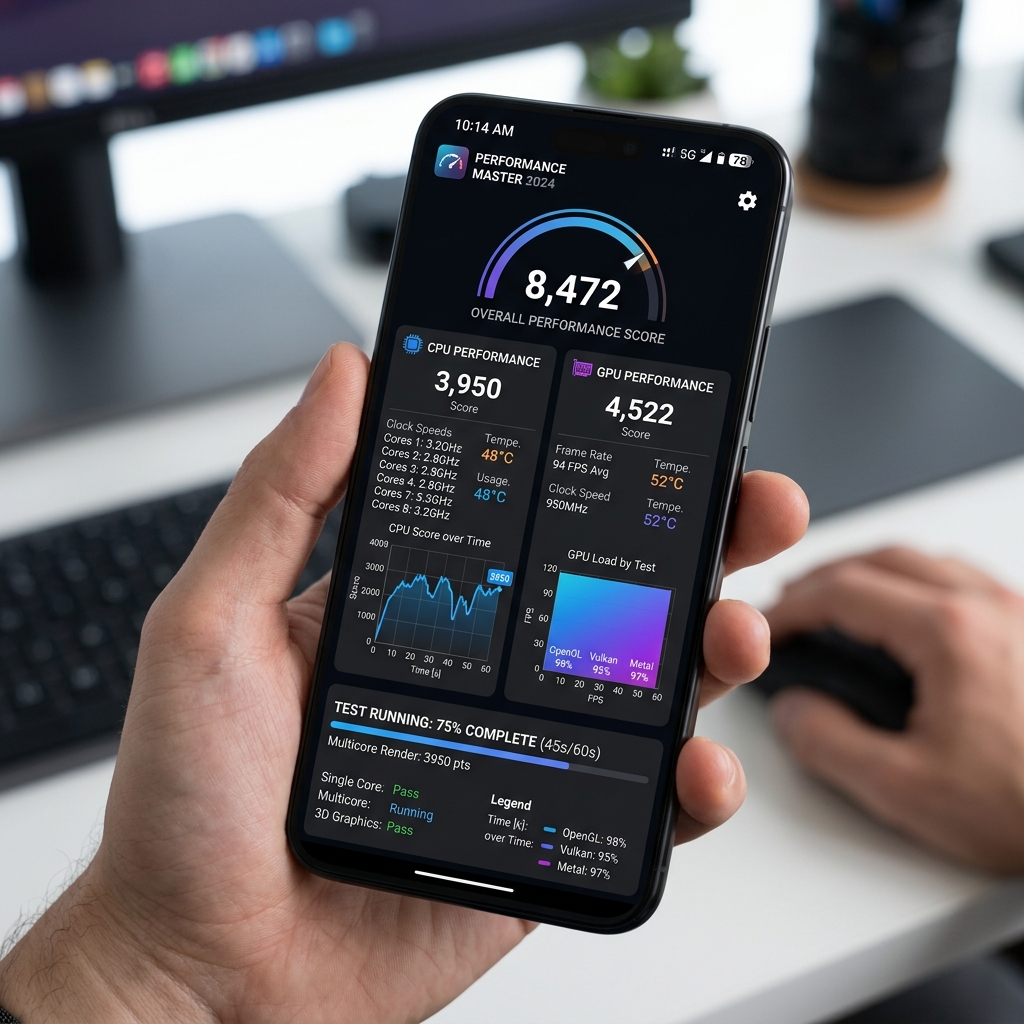
App Performance and Multitasking
A more powerful chipset opens apps faster, switches between running apps more smoothly, and handles demanding productivity tasks like video editing and document processing with ease. Budget chipsets may exhibit noticeable lag when running multiple apps simultaneously or handling resource-intensive applications.
Gaming
The GPU component of the chipset directly determines gaming performance. Flagship chipsets can run graphically demanding games at high frame rates with maximum visual settings. Mid-range chipsets handle most games well at medium settings, while budget chipsets may struggle with newer 3D titles.
Camera Quality
The ISP and NPU in the chipset significantly influence camera performance. Advanced chipsets process Night Mode photos faster, handle HDR more effectively, enable real-time AI scene detection, and support higher resolution video recording with better stabilization. Two phones with identical camera hardware but different chipsets can produce noticeably different photo quality.
Battery Life
Chipset manufacturing process (measured in nanometers) directly affects power efficiency. Smaller process nodes like 3nm and 4nm produce less heat and consume less power than older 7nm or 10nm processes. A more efficient chipset translates to longer battery life for the same battery capacity.
Conclusion
The chipset is the single most important hardware component in your smartphone, influencing every aspect of the user experience from raw processing speed and gaming performance to camera quality and battery life. Understanding what a chipset contains and how its components work together helps you make informed purchasing decisions. When comparing phones in 2026, paying attention to the chipset tells you more about real-world performance than almost any other specification.